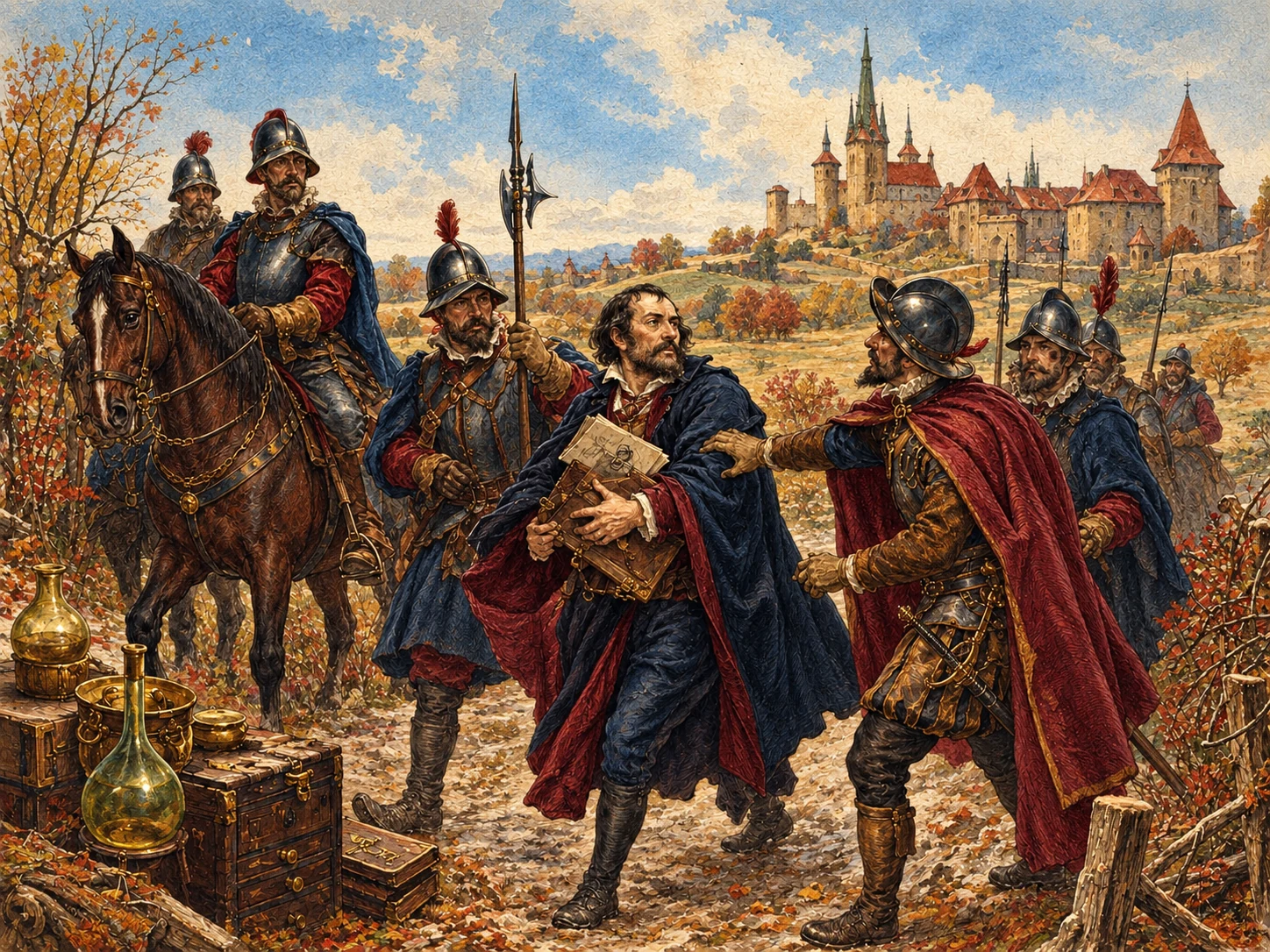
At the end of the sixteenth century, Edward Kelly was among the most enigmatic figures at the imperial court in Prague. The Englishman, who moved among astrologers, magicians and alchemists, managed to arouse the interest of Emperor Rudolf II himself. He claimed to know the secret of turning ordinary metals into gold and to command processes of which other alchemists could only dream.
At first he prospered at the Prague court. Rudolf II was fascinated by alchemy, and Kelly was precisely the kind of man the emperor sought: a mysterious foreigner promising something almost impossible. Yet the longer Kelly stayed in Prague, the more doubts, disputes and enemies gathered around him. The promised gold failed to materialise, and the emperor’s patience was wearing thin.
Then came the year 1591.
Kelly found himself in serious trouble and decided to leave Prague. The emperor’s wrath was gathering over him, and it was clear that if he were caught, his former standing at court would offer little protection. He headed south from Prague. His destination may have been the Rožmberk estates, where he perhaps hoped to find refuge. His route led through South Bohemia, and Kelly apparently tried to travel as quickly as possible. The imperial orders, however, moved faster.
In February 1591 he arrived in Soběslav. It was here that his escape ended.
The emperor’s men arrested Kelly, and tradition says he was held for a time at Soběslav Castle as well. Within a few days, a man who had recently entered Rudolf II’s chambers and spoken of the philosopher’s stone became a prisoner. Kelly probably knew very well that the return journey would not mean a return to the comforts of the imperial court.
He was eventually taken from Soběslav to Křivoklát. The massive castle, surrounded by deep forests, became his prison and later the setting for a number of dark stories.
Rudolf II did not simply wish to dispose of his alchemist. A single question still interested him: did Kelly really know the secret of making gold? This is one of the strangest aspects of the entire story. Had Kelly been considered merely an ordinary swindler, his fate might have been sealed quickly. But the emperor apparently still hoped that the Englishman would eventually reveal his secret.
In prison Kelly negotiated, wrote and tried to regain the emperor’s favour. Later legends even claim that he was interrogated and forced to divulge the secret of transmutation. Today it is no longer easy to distinguish exactly what happened behind Křivoklát’s walls from the legends.
One thing, however, is certain: Edward Kelly wanted to leave Křivoklát.
He decided to escape. According to the traditional account, he tried to lower himself from the walls on a rope. The escape ended in disaster. Kelly fell and badly injured his leg. A widespread tradition holds that the injury was so severe that he lost part of it.
Fate played an almost cruel game with him. The man who supposedly mastered the secrets of transforming matter and making gold could not save his own body.
After several years Kelly nevertheless regained his freedom. It seemed that the worst period of his life was over. Once again he tried to win Rudolf’s trust and return, at least in part, to the life he had known before his arrest. But his problems did not disappear. His debts grew, his position weakened, and the emperor’s patience was nearly exhausted.
In 1596 Edward Kelly was arrested again. This time he was taken to Hněvín Castle above Most. There began the final chapter of his life.
Even in his second prison he did not abandon the thought of freedom. Although the first escape had left him severely impaired, he began planning another route over the walls. Tradition says that this time his family was to help him too.
Again there was a rope. Again a castle wall. And again a fall.
In his second escape attempt Kelly seriously injured his other leg as well. For a man already living with the consequences of the first fall, it meant an almost complete loss of hope. The man who had once walked through Prague’s imperial court promising to make gold remained badly injured behind the castle walls.
And it is here that reality once again begins to mingle with legend.
According to the most widespread account, Kelly realised that another escape would no longer be possible. One tradition says he took poison that he had prepared himself. Another version says he succumbed to the severe injuries caused by his final fall. Edward Kelly died in 1597.
We will probably never learn the truth about his final days. Equally uncertain is the question that accompanied him for almost his entire life: could he really make gold?
Was he a brilliant alchemist who hid the true secret of transmutation from the emperor? Or an extraordinarily capable adventurer who managed to convince one of Europe’s most powerful rulers? Rudolf II may long have hoped that Kelly would one day reveal his secret. If he had one, he took it to his grave.
Yet one specific place remains in this whole story where his fate took its decisive turn: Soběslav.
Here ended the flight of the man who sought the philosopher’s stone. From here his path led through Křivoklát to his final prison at Hněvín.
Edward Kelly sought the secret of gold and perhaps a path to immortality. In the end he lost his property, health and freedom. He left no gold behind. But he left a legend.
Location and map
- Place
- Soběslav
- Municipality / starting point
- Soběslav
- District / region
- Tábor
- Country
- Czechia
- Distance and direction
- 18 km S of Tábora
At the end of the sixteenth century, Edward Kelly was among the most enigmatic figures at the imperial court in Prague. The Englishman, who moved among astrologers, magicians and alchemists, managed to arouse the interest of Emperor Rudolf II himself. He claimed to know the secret of turning ordinary metals into gold and to command processes of which other alchemists could only dream.
The link searches for Soběslav and its surroundings. The sources do not establish the precise point of this legend.
Approximate location · municipality or area search. The distance comes from the sources, not a currently calculated route.
Sources of the original atlas Tajemná místa · page 319
This legend preserves a folk tale. Its motifs do not constitute evidence of supernatural events.